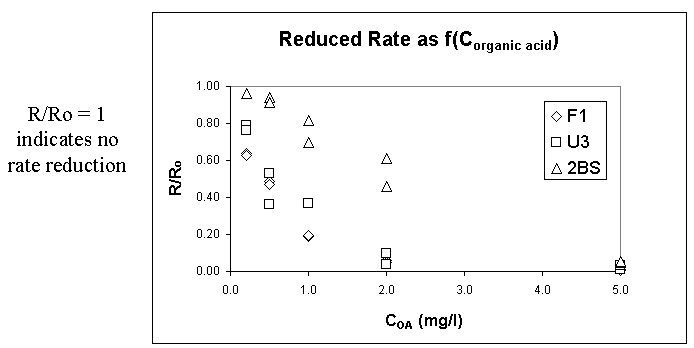

Of the three organic acids studied, the sample from the F1 site was the strongest inhibitor, followed by U3 and 2BS. Note that the F1 inhibitors slowed the growth reaction to about 60% of the control rate at 0.2 mg/l organic acid concentration, which is very low compared to natural Everglades waters.
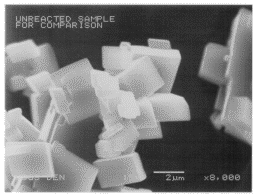
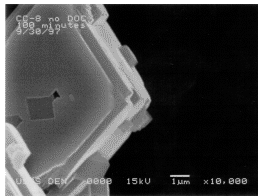
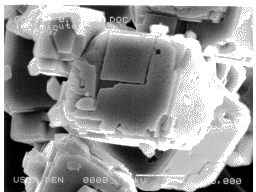
Scanning electron microscope images were obtained for unreacted seed crystals, seed crystal grown for 100 minutes in the absence of organic acids and seed crystals grown for 100 minutes with organic acid, such that R/Ro = 0.5, or 50%
|
Unreacted seed crystals (Baker Chemical ACS grade CaCO3) show well-developed rhombohedral morphology, with sharp, straight edges. |
|
Control experiments with no organic acids yielded morphologies characterized by continuous planes of new crystal growth, with smooth edges and step features on the face perimeters. Crystal mass was increased by about 25% in control experiments. |
|
Crystals grown in the presence of organic acids such that R/Ro = 0.5 exhibit planes of new growth that are not continuous, because "poisoning" of growth sites by adsorbed organic acids has prevented surface-nucleated growth spirals from coalescing. Crystal mass increased by about 50% of the control experiment above (13%). |

