EXAMPLES
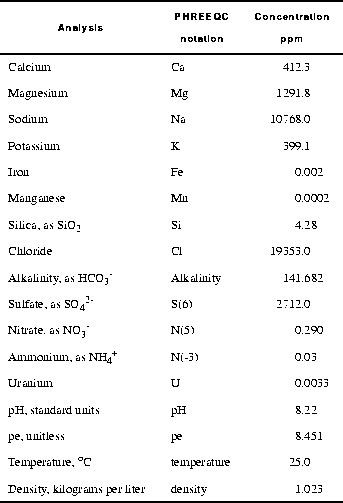
A comment about the calculations performed in this simulation is included with the TITLE keyword. The essential data needed for a speciation calculation are the temperature, pH, and concentrations of elements and (or) element valence states (table 2). The input data set corresponding to the analytical data are shown in table 3 under the keyword SOLUTION. Note that valence states are identified by the chemical symbol for the element followed by the valence in parentheses [S(6), N(5), N(-3), and O(0)]. The default units are specified to be ppm in this data set. This default can be overridden for any concentration, as demonstrated by the uranium concentration, which is specified to be ppb instead of ppm.
TITLE Example 1.--Add uranium and speciate seawater.
SOLUTION 1  SEAWATER FROM NORDSTROM ET AL. (1979)
        units   ppm
        pH      8.22
        pe      8.451
        density 1.023
        temp    25.0
        redox   O(0)/O(-2)
        Ca              412.3
        Mg              1291.8
        Na              10768.0
        K               399.1
        Fe              0.002
        Mn              0.0002  pe
        Si              4.28
        Cl              19353.0
        Alkalinity      141.682 as HCO3
        S(6)            2712.0
        N(5)            0.29    as NO3
        N(-3)           0.03    as NH4
        U               3.3     ppb     N(5)/N(-3)
        O(0)            1.0     O2(g)   -0.7
SOLUTION_MASTER_SPECIES
        U       U+4     0.0     238.0290     238.0290
        U(4)    U+4     0.0     238.0290
        U(5)    UO2+    0.0     238.0290
        U(6)    UO2+2   0.0     238.0290
SOLUTION_SPECIES
        #primary master species for U
        #secondary master species for U+4
        U+4 = U+4
                log_k          0.0
        U+4 + 4 H2O = U(OH)4 + 4 H+
                log_k          -8.538
                delta_h        24.760 kcal
        U+4 + 5 H2O = U(OH)5- + 5 H+
                log_k          -13.147
                delta_h        27.580 kcal
        #secondary master species for U(5)
        U+4 + 2 H2O = UO2+ + 4 H+ + e-
                log_k          -6.432
                delta_h        31.130 kcal
        #secondary master species for U(6)
        U+4 + 2 H2O = UO2+2 + 4 H+ + 2 e-
                log_k          -9.217
                delta_h        34.430 kcal
        UO2+2 + H2O = UO2OH+ + H+
                log_k          -5.782
                delta_h        11.015 kcal
        2UO2+2 + 2H2O = (UO2)2(OH)2+2 + 2H+
                log_k          -5.626
                delta_h        -36.04 kcal
        3UO2+2 + 5H2O = (UO2)3(OH)5+ + 5H+
                log_k          -15.641
                delta_h        -44.27 kcal
        UO2+2 + CO3-2 = UO2CO3
                log_k          10.064
                delta_h        0.84 kcal
        UO2+2 + 2CO3-2 = UO2(CO3)2-2
                log_k          16.977
                delta_h        3.48 kcal
        UO2+2 + 3CO3-2 = UO2(CO3)3-4
                log_k          21.397
                delta_h        -8.78 kcal
PHASES
        Uraninite
        UO2 + 4 H+ = U+4 + 2 H2O
        log_k          -3.490
        delta_h        -18.630 kcal
END
------------------
Reading data base.
------------------
SOLUTION_SPECIES
SOLUTION_MASTER_SPECIES
PHASES
EXCHANGE_MASTER_SPECIES
EXCHANGE_SPECIES
SURFACE_MASTER_SPECIES
SURFACE_SPECIES
END
------------------------------------
Reading input data for simulation 1.
------------------------------------
TITLE Example 1.--Add uranium and speciate seawater.
SOLUTION 1 SEAWATER FROM NORDSTROM ET AL. (1979)
units ppm
pH 8.22
pe 8.451
density 1.023
temp 25.0
redox O(0)/O(-2)
Ca 412.3
Mg 1291.8
Na 10768.0
K 399.1
Fe 0.002
Mn 0.0002 pe
Si 4.28
Cl 19353.0
Alkalinity 141.682 as HCO3
S(6) 2712.0
N(5) 0.29 as NO3
N(-3) 0.03 as NH4
U 3.3 ppb N(5)/N(-3)
O(0) 1.0 O2(g) -0.7
SOLUTION_MASTER_SPECIES
U U+4 0.0 238.0290 238.0290
U(4) U+4 0.0 238.0290
U(5) UO2+ 0.0 238.0290
U(6) UO2+2 0.0 238.0290
SOLUTION_SPECIES
U+4 = U+4
log_k 0.0
U+4 + 4 H2O = U(OH)4 + 4 H+
log_k -8.538
delta_h 24.760 kcal
U+4 + 5 H2O = U(OH)5- + 5 H+
log_k -13.147
delta_h 27.580 kcal
U+4 + 2 H2O = UO2+ + 4 H+ + e-
log_k -6.432
delta_h 31.130 kcal
U+4 + 2 H2O = UO2+2 + 4 H+ + 2 e-
log_k -9.217
delta_h 34.430 kcal
UO2+2 + H2O = UO2OH+ + H+
log_k -5.782
delta_h 11.015 kcal
2UO2+2 + 2H2O = (UO2)2(OH)2+2 + 2H+
log_k -5.626
delta_h -36.04 kcal
3UO2+2 + 5H2O = (UO2)3(OH)5+ + 5H+
log_k -15.641
delta_h -44.27 kcal
UO2+2 + CO3-2 = UO2CO3
log_k 10.064
delta_h 0.84 kcal
UO2+2 + 2CO3-2 = UO2(CO3)2-2
log_k 16.977
delta_h 3.48 kcal
UO2+2 + 3CO3-2 = UO2(CO3)3-4
log_k 21.397
delta_h -8.78 kcal
PHASES
Uraninite
UO2 + 4 H+ = U+4 + 2 H2O
log_k -3.490
delta_h -18.630 kcal
END
-----
TITLE
-----
Example 1.--Add uranium and speciate seawater.
-------------------------------------------
Beginning of initial solution calculations.
-------------------------------------------
Initial solution 1. SEAWATER FROM NORDSTROM ET AL. (1979)
-----------------------------Solution composition------------------------------
Elements Molality Moles
Alkalinity 2.406e-03 2.406e-03
Ca 1.066e-02 1.066e-02
Cl 5.657e-01 5.657e-01
Fe 3.711e-08 3.711e-08
K 1.058e-02 1.058e-02
Mg 5.507e-02 5.507e-02
Mn 3.773e-09 3.773e-09
N(-3) 1.724e-06 1.724e-06
N(5) 4.847e-06 4.847e-06
Na 4.854e-01 4.854e-01
O(0) 3.746e-04 3.746e-04 Equilibrium with O2(g)
S(6) 2.926e-02 2.926e-02
Si 7.382e-05 7.382e-05
U 1.437e-08 1.437e-08
----------------------------Description of solution----------------------------
pH = 8.220
pe = 8.451
Activity of water = 0.981
Ionic strength = 6.750e-01
Mass of water (kg) = 1.000e+00
Total carbon (mol/kg) = 2.180e-03
Total CO2 (mol/kg) = 2.180e-03
Temperature (deg C) = 25.000
Electrical balance (eq) = 7.936e-04
Iterations = 7
Total H = 1.110147e+02
Total O = 5.563047e+01
---------------------------------Redox couples---------------------------------
Redox couple pe Eh (volts)
N(-3)/N(5) 4.6750 0.2767
O(-2)/O(0) 12.3893 0.7333
----------------------------Distribution of species----------------------------
Log Log Log
Species Molality Activity Molality Activity Gamma
OH- 2.678e-06 1.629e-06 -5.572 -5.788 -0.216
H+ 7.987e-09 6.026e-09 -8.098 -8.220 -0.122
H2O 5.551e+01 9.806e-01 -0.009 -0.009 0.000
C(4) 2.180e-03
HCO3- 1.515e-03 1.023e-03 -2.820 -2.990 -0.171
MgHCO3+ 2.190e-04 1.635e-04 -3.659 -3.786 -0.127
NaHCO3 1.665e-04 1.945e-04 -3.779 -3.711 0.068
MgCO3 8.885e-05 1.038e-04 -4.051 -3.984 0.068
NaCO3- 6.716e-05 5.013e-05 -4.173 -4.300 -0.127
CaHCO3+ 4.585e-05 3.095e-05 -4.339 -4.509 -0.171
CO3-2 3.836e-05 7.959e-06 -4.416 -5.099 -0.683
CaCO3 2.715e-05 3.171e-05 -4.566 -4.499 0.068
CO2 1.209e-05 1.413e-05 -4.917 -4.850 0.068
UO2(CO3)3-4 1.256e-08 1.169e-10 -7.901 -9.932 -2.031
UO2(CO3)2-2 1.798e-09 5.583e-10 -8.745 -9.253 -0.508
MnCO3 2.691e-10 3.144e-10 -9.570 -9.503 0.068
MnHCO3+ 6.071e-11 4.532e-11 -10.217 -10.344 -0.127
UO2CO3 7.337e-12 8.570e-12 -11.134 -11.067 0.068
FeCO3 1.952e-20 2.280e-20 -19.710 -19.642 0.068
FeHCO3+ 1.636e-20 1.221e-20 -19.786 -19.913 -0.127
Ca 1.066e-02
Ca+2 9.510e-03 2.372e-03 -2.022 -2.625 -0.603
CaSO4 1.078e-03 1.260e-03 -2.967 -2.900 0.068
CaHCO3+ 4.585e-05 3.095e-05 -4.339 -4.509 -0.171
CaCO3 2.715e-05 3.171e-05 -4.566 -4.499 0.068
CaOH+ 8.582e-08 6.406e-08 -7.066 -7.193 -0.127
Cl 5.657e-01
Cl- 5.657e-01 3.523e-01 -0.247 -0.453 -0.206
MnCl+ 9.561e-10 7.137e-10 -9.020 -9.146 -0.127
MnCl2 9.396e-11 1.098e-10 -10.027 -9.960 0.068
MnCl3- 1.427e-11 1.065e-11 -10.846 -10.973 -0.127
FeCl+2 9.576e-19 2.974e-19 -18.019 -18.527 -0.508
FeCl2+ 6.270e-19 4.680e-19 -18.203 -18.330 -0.127
FeCl+ 7.781e-20 5.809e-20 -19.109 -19.236 -0.127
FeCl3 1.412e-20 1.649e-20 -19.850 -19.783 0.068
Fe(2) 6.926e-19
Fe+2 5.223e-19 1.194e-19 -18.282 -18.923 -0.641
FeCl+ 7.781e-20 5.809e-20 -19.109 -19.236 -0.127
FeSO4 4.839e-20 5.652e-20 -19.315 -19.248 0.068
FeCO3 1.952e-20 2.280e-20 -19.710 -19.642 0.068
FeHCO3+ 1.636e-20 1.221e-20 -19.786 -19.913 -0.127
FeOH+ 8.233e-21 6.146e-21 -20.084 -20.211 -0.127
FeHSO4+ 2.999e-27 2.239e-27 -26.523 -26.650 -0.127
Fe(3) 3.711e-08
Fe(OH)3 2.840e-08 3.317e-08 -7.547 -7.479 0.068
Fe(OH)4- 6.595e-09 4.924e-09 -8.181 -8.308 -0.127
Fe(OH)2+ 2.120e-09 1.582e-09 -8.674 -8.801 -0.127
FeOH+2 9.456e-14 2.937e-14 -13.024 -13.532 -0.508
FeSO4+ 1.093e-18 8.156e-19 -17.962 -18.089 -0.127
FeCl+2 9.576e-19 2.974e-19 -18.019 -18.527 -0.508
FeCl2+ 6.270e-19 4.680e-19 -18.203 -18.330 -0.127
Fe+3 3.529e-19 2.795e-20 -18.452 -19.554 -1.101
Fe(SO4)2- 6.362e-20 4.749e-20 -19.196 -19.323 -0.127
FeCl3 1.412e-20 1.649e-20 -19.850 -19.783 0.068
Fe2(OH)2+4 2.495e-24 2.321e-26 -23.603 -25.634 -2.031
FeHSO4+2 4.238e-26 1.316e-26 -25.373 -25.881 -0.508
Fe3(OH)4+5 1.146e-29 7.675e-33 -28.941 -32.115 -3.174
H(0) 0.000e+00
H2 0.000e+00 0.000e+00 -44.436 -44.369 0.068
K 1.058e-02
K+ 1.041e-02 6.486e-03 -1.982 -2.188 -0.206
KSO4- 1.637e-04 1.222e-04 -3.786 -3.913 -0.127
KOH 3.133e-09 3.660e-09 -8.504 -8.437 0.068
Mg 5.507e-02
Mg+2 4.745e-02 1.367e-02 -1.324 -1.864 -0.541
MgSO4 7.299e-03 8.526e-03 -2.137 -2.069 0.068
MgHCO3+ 2.190e-04 1.635e-04 -3.659 -3.786 -0.127
MgCO3 8.885e-05 1.038e-04 -4.051 -3.984 0.068
MgOH+ 1.082e-05 8.074e-06 -4.966 -5.093 -0.127
Mn(2) 3.773e-09
Mn+2 2.174e-09 4.973e-10 -8.663 -9.303 -0.641
MnCl+ 9.561e-10 7.137e-10 -9.020 -9.146 -0.127
MnCO3 2.691e-10 3.144e-10 -9.570 -9.503 0.068
MnSO4 2.015e-10 2.353e-10 -9.696 -9.628 0.068
MnCl2 9.396e-11 1.098e-10 -10.027 -9.960 0.068
MnHCO3+ 6.071e-11 4.532e-11 -10.217 -10.344 -0.127
MnCl3- 1.427e-11 1.065e-11 -10.846 -10.973 -0.127
MnOH+ 2.786e-12 2.080e-12 -11.555 -11.682 -0.127
Mn(NO3)2 1.369e-20 1.599e-20 -19.864 -19.796 0.068
Mn(3) 6.029e-26
Mn+3 6.029e-26 4.341e-27 -25.220 -26.362 -1.143
N(-3) 1.724e-06
NH4+ 1.610e-06 9.042e-07 -5.793 -6.044 -0.251
NH3 7.191e-08 8.400e-08 -7.143 -7.076 0.068
NH4SO4- 4.153e-08 3.100e-08 -7.382 -7.509 -0.127
N(5) 4.847e-06
NO3- 4.847e-06 2.842e-06 -5.315 -5.546 -0.232
Mn(NO3)2 1.369e-20 1.599e-20 -19.864 -19.796 0.068
Na 4.854e-01
Na+ 4.791e-01 3.383e-01 -0.320 -0.471 -0.151
NaSO4- 6.045e-03 4.512e-03 -2.219 -2.346 -0.127
NaHCO3 1.665e-04 1.945e-04 -3.779 -3.711 0.068
NaCO3- 6.716e-05 5.013e-05 -4.173 -4.300 -0.127
NaOH 3.114e-07 3.637e-07 -6.507 -6.439 0.068
O(0) 3.746e-04
O2 1.873e-04 2.188e-04 -3.728 -3.660 0.068
S(6) 2.926e-02
SO4-2 1.467e-02 2.661e-03 -1.834 -2.575 -0.741
MgSO4 7.299e-03 8.526e-03 -2.137 -2.069 0.068
NaSO4- 6.045e-03 4.512e-03 -2.219 -2.346 -0.127
CaSO4 1.078e-03 1.260e-03 -2.967 -2.900 0.068
KSO4- 1.637e-04 1.222e-04 -3.786 -3.913 -0.127
NH4SO4- 4.153e-08 3.100e-08 -7.382 -7.509 -0.127
HSO4- 2.089e-09 1.559e-09 -8.680 -8.807 -0.127
MnSO4 2.015e-10 2.353e-10 -9.696 -9.628 0.068
FeSO4+ 1.093e-18 8.156e-19 -17.962 -18.089 -0.127
Fe(SO4)2- 6.362e-20 4.749e-20 -19.196 -19.323 -0.127
FeSO4 4.839e-20 5.652e-20 -19.315 -19.248 0.068
FeHSO4+2 4.238e-26 1.316e-26 -25.373 -25.881 -0.508
FeHSO4+ 2.999e-27 2.239e-27 -26.523 -26.650 -0.127
Si 7.382e-05
H4SiO4 7.110e-05 8.306e-05 -4.148 -4.081 0.068
H3SiO4- 2.723e-06 2.032e-06 -5.565 -5.692 -0.127
H2SiO4-2 7.388e-11 2.294e-11 -10.131 -10.639 -0.508
U(4) 1.022e-21
U(OH)5- 1.022e-21 7.631e-22 -20.990 -21.117 -0.127
U(OH)4 1.632e-25 1.906e-25 -24.787 -24.720 0.068
U+4 0.000e+00 0.000e+00 -46.996 -49.028 -2.031
U(5) 1.604e-18
UO2+ 1.604e-18 1.197e-18 -17.795 -17.922 -0.127
U(6) 1.437e-08
UO2(CO3)3-4 1.256e-08 1.169e-10 -7.901 -9.932 -2.031
UO2(CO3)2-2 1.798e-09 5.583e-10 -8.745 -9.253 -0.508
UO2CO3 7.337e-12 8.570e-12 -11.134 -11.067 0.068
UO2OH+ 3.347e-14 2.498e-14 -13.475 -13.602 -0.127
UO2+2 2.992e-16 9.293e-17 -15.524 -16.032 -0.508
(UO2)2(OH)2+2 1.742e-21 5.411e-22 -20.759 -21.267 -0.508
(UO2)3(OH)5+ 2.804e-23 2.093e-23 -22.552 -22.679 -0.127
------------------------------Saturation indices-------------------------------
Phase SI log IAP log KT
Anhydrite -0.84 -5.20 -4.36 CaSO4
Aragonite 0.61 -7.72 -8.34 CaCO3
Calcite 0.76 -7.72 -8.48 CaCO3
Chalcedony -0.51 -4.06 -3.55 SiO2
Chrysotile 3.36 35.56 32.20 Mg3Si2O5(OH)4
CO2(g) -3.38 -21.53 -18.15 CO2
Dolomite 2.40 -14.69 -17.09 CaMg(CO3)2
Fe(OH)3(a) 0.19 -3.42 -3.61 Fe(OH)3
Goethite 6.09 -3.41 -9.50 FeOOH
Gypsum -0.64 -5.22 -4.58 CaSO4:2H2O
H2(g) -41.22 1.82 43.04 H2
Hausmannite 1.56 19.55 17.99 Mn3O4
Hematite 14.20 -6.81 -21.01 Fe2O3
Jarosite-K -7.52 -42.23 -34.71 KFe3(SO4)2(OH)6
Manganite 2.39 6.21 3.82 MnOOH
Melanterite -19.35 -21.56 -2.21 FeSO4:7H2O
NH3(g) -8.85 2.18 11.02 NH3
O2(g) -0.70 -3.66 -2.96 O2
Pyrochroite -8.08 7.12 15.20 Mn(OH)2
Pyrolusite 6.96 5.30 -1.66 MnO2
Quartz -0.08 -4.06 -3.98 SiO2
Rhodochrosite -3.27 -14.40 -11.13 MnCO3
Sepiolite 1.15 16.91 15.76 Mg2Si3O7.5OH:3H2O
Sepiolite(d) -1.75 16.91 18.66 Mg2Si3O7.5OH:3H2O
Siderite -13.13 -24.02 -10.89 FeCO3
SiO2(a) -1.35 -4.06 -2.71 SiO2
Talc 6.04 27.44 21.40 Mg3Si4O10(OH)2
Uraninite -12.67 4.39 17.06 UO2
The pe to be used for distributing redox elements and for calculating saturation indices is specified by the redox identifier. In this example, a pe is to be calculated from the O(-2)/O(0) redox couple, which corresponds to the dissolved oxygen/water couple, and this calculated pe will be used for all calculations that require a pe. If redox were not specified, the default would be the input pe. The default redox identifier can be overridden for any redox element, as demonstrated by the manganese input, where the input pe will be used to speciate manganese among its valence states, and the uranium input, where the nitrate/ammonium couple will be used to calculate a pe with which to speciate uranium among its valence states. Because ppm is a mass unit, not a mole unit, the program must use a gram formula weight to convert each concentration into molal units. The default gram formula weights for each master species are specified in the SOLUTION_MASTER_SPECIES input (the values for the default database phreeqc.dat are listed in table 1 and in Attachment B). If the data are reported relative to a gram formula weight different from the default, it is necessary to specify the appropriate gram formula weight in the input data set. This can be done with the gfw identifier, where the actual gram formula weight is input, or more simply with the as identifier, where the chemical formula for the reported units is input, as shown in the input for alkalinity, nitrate, and ammonium in this example. Note finally that the concentration of O(0), dissolved oxygen, is given an initial estimate of 1 ppm, but that its concentration will be adjusted until a log partial pressure of oxygen gas of -0.7 is achieved. [O2(g) is defined under PHASES input of the default database file (Attachment B).] It is important to realize when using phase equilibria to specify initial concentrations [like O(0) in this example] that only one concentration is adjusted. For example, if gypsum were used to adjust the calcium concentration, the concentration of calcium would vary, but the concentration of sulfate would remain fixed.Uranium is not included in phreeqc.dat, the smaller of the two database files that are distributed with the program. Thus data to describe the thermodynamics and composition of aqueous uranium species must be included in the input data when using this database file. Two keyword data blocks are needed to define the uranium species, SOLUTION_MASTER_SPECIES and SOLUTION_SPECIES. By adding these two data blocks to the input data file, aqueous uranium species will be defined for the duration of the run. To add uranium permanently to the list of elements, these data blocks should be added to the database file. The data for uranium shown here are intended to be illustrative and are not a complete description of uranium speciation.
It is necessary to define a primary master species for uranium with SOLUTION_MASTER_SPECIES input. Because uranium is a redox-active element, it is also necessary to define a secondary master species for each valence state of uranium. The data block SOLUTION_MASTER_SPECIES (table 3) defines U+4 as the primary master species for uranium and the secondary master species for the +4 valence state. UO2+ is the secondary master species for the +5 valence state, and UO2+2 is the secondary master species for the +6 valence state. Equations defining these aqueous species plus any other complexes of uranium must be defined through SOLUTION_SPECIES input.
In the data block SOLUTION_SPECIES (table 3), the primary and secondary master species are noted with comments. A primary master species is always defined with an identity reaction. Secondary master species are the only aqueous species that contain electrons in their chemical reaction. Additional hydroxide and carbonate complexes are defined for the +4 and +6 valence states, but none for the +5 state.
Finally, a new phase, uraninite, is defined with PHASES input. This phase will be used in calculating saturation indices in speciation modeling, but could also be used, without redefinition, for reaction or inverse modeling within the computer run.
The output from the model (table 4) contains several blocks of information delineated by headings. First, all keywords encountered in reading the database file are listed under the heading "Reading data base." Next, the input data, excluding comments and empty lines, is echoed under the heading "Reading input data for simulation 1". The simulation is defined by all input data up to and including the END keyword.
The next heading is "Beginning of initial solution calculations", below which are the results of the speciation calculation for seawater. The concentration data, converted to molality are given under the subheading "Solution composition". For initial solution calculations, the number of moles in solution is numerically equal to molality, because 1 kg of water is assumed. During reaction calculations, the mass of water may change and the number of moles in the aqueous phase will not exactly equal the molality of a constituent. Note that the molality of dissolved oxygen that produces a log partial pressure of -0.7 has been calculated and is annotated in the output.
After the subheading "Description of solution", some of the properties listed in the first block of output are equal to their input values and some are calculated. In this example, pH, pe, and temperature are equal to the input values. The ionic strength, total carbon (alkalinity was the input datum), total inorganic carbon ("Total CO2"), and electrical balance of the solution have been calculated by the model.
Under the subheading "Redox couples" the pe and Eh are printed for each redox couple for which data were available, in this case, nitrate/ammonium and dissolved oxygen/water.
Under the subheading "Distribution of species", the molalities, activities, and activity coefficients of all species of each element and element valence state are listed. The lists are alphabetical by element name and descending in terms of molality within each element or element valence state. Beside the name of each element or element valence state, the total molality is given.
Finally, under the subheading "Saturation indices", saturation indices for all minerals that are appropriate for the given analytical data are listed alphabetically by phase name near the end of the output. The chemical formulas for each of the phases is printed in the right-hand column. Note, for example, that no aluminum bearing minerals are included because aluminum was not included in the analytical data. Also note that mackinawite (FeS) and other sulfide minerals are not included in the output because no analytical data were specified for S(-2). If a concentration for S [instead of S(6)] or S(-2) had been entered, then a concentration of S(-2) would have been calculated and a saturation index for mackinawite and other sulfide minerals would have been calculated.