EXAMPLES
TITLE
Example 2.--Temperature dependence of solubility
            of gypsum and anhydrite
SOLUTION 1 Pure water
        pH      7.0
        temp    25.0
EQUILIBRIUM_PHASES 1
        Gypsum          0.0     1.0
        Anhydrite       0.0     1.0
REACTION_TEMPERATURE 1
        25.0 75.0 in 51 steps
SELECTED_OUTPUT
        -file   ex2.pun
        -si     anhydrite  gypsum
END
A set of 51 temperatures is specified in the REACTION_TEMPERATURE data block. The input data specify that for every degree of temperature, beginning at 25oC and ending at 75oC, the phases defined by EQUILIBRIUM_PHASES (gypsum and anhydrite) will react to attain equilibrium, if possible, or until both phases are completely dissolved. Finally, SELECTED_OUTPUT is used to write the saturation indices for gypsum and anhydrite to the file ex2.pun after each calculation. This file was then used to generate figure 1.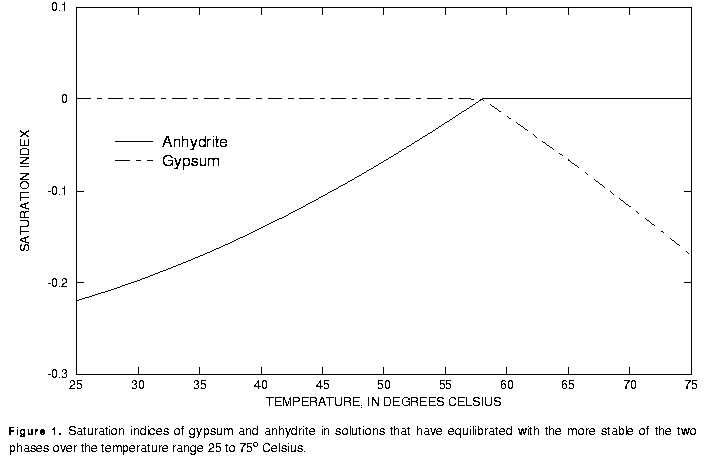
The results of the initial solution calculation and the first reaction step are shown in table 6. The distribution of species for pure water is shown under the heading "Beginning of initial solution calculations". The equilibration of the system with the given amounts of gypsum and anhydrite at 25oC is the first reaction step, which is displayed after the heading "Beginning of reaction calculations". Immediately following this heading, the reaction step is identified, followed by a list of the identity of the keyword data used in the calculation. In this example, the solution composition stored as number 1, the pure-phase assemblage stored as number 1, and the reaction temperatures stored as number 1 are used in the calculation. Conceptually, the solution and the pure phases are put together in a beaker, which is regulated to 25oC, and allowed to react to system equilibrium.
Under the subheading "Phase assemblage", the saturation indices and amounts of each of the phases defined by EQUILIBRIUM_PHASES are listed. In the first reaction step, the final phase assemblage contains no anhydrite, which is undersaturated with respect to the solution (saturation index equals -0.22), and 1.985 mol of gypsum, which is in equilibrium with the solution (saturation index equals 0.0). All of the anhydrite has dissolved and most of the calcium and sulfate have reprecipitated as gypsum. The "Solution composition" indicates that 15.67 mmol/kg water of calcium and sulfate remain in solution, which defines the solubility of gypsum in pure water. However, the total number of moles of each constituent in the aqueous phase is only 15.11 because the mass of water is only 0.9645 kg ("Description of solution"). In precipitating gypsum (CaSO4.2H2O), water has been removed from solution. Thus, the mass of solvent water is not constant in reaction calculations as it was in PHREEQE; reactions and waters of hydration in dissolving and precipitating phases may increase or decrease the mass of solvent water.
The saturation indices for all of the reaction steps are plotted in figure 1. In each step, pure water was reacted with the phases at a different temperature (the reactions are not cumulative). The default database for PHREEQC indicates that gypsum is the stable phase (saturation index equals 0.0) at temperatures below about 57oC; above this temperature, anhydrite is the stable phase.
------------------
Reading data base.
------------------
        SOLUTION_SPECIES
        SOLUTION_MASTER_SPECIES
        PHASES
        EXCHANGE_MASTER_SPECIES
        EXCHANGE_SPECIES
        SURFACE_MASTER_SPECIES
        SURFACE_SPECIES
        END
------------------------------------
Reading input data for simulation 1.
------------------------------------
        TITLE
        Example 2.--Temperature dependence of solubility
                    of gypsum and anhydrite
        SOLUTION 1 Pure water
                pH      7.0
                temp    25.0
        EQUILIBRIUM_PHASES 1
                Gypsum          0.0     1.0
                Anhydrite       0.0     1.0
        REACTION_TEMPERATURE 1
                25.0 75.0 in 51 steps
        SELECTED_OUTPUT
                file   ex2.pun
                si     anhydrite  gypsum
        END
-----
TITLE
-----
Example 2.--Temperature dependence of solubility
            of gypsum and anhydrite
-------------------------------------------
Beginning of initial solution calculations.
-------------------------------------------
Initial solution 1.     Pure water
-----------------------------Solution composition------------------------------

        Elements           Molality       Moles
        Pure water
----------------------------Description of solution----------------------------
                             pH  =   7.000
                             pe  =   4.000
              Activity of water  =   1.000
                 Ionic strength  =   1.001e-07
             Mass of water (kg)  =   1.000e+00
       Total alkalinity (eq/kg)  =   1.082e-10
          Total carbon (mol/kg)  =   0.000e+00
             Total CO2 (mol/kg)  =   0.000e+00
            Temperature (deg C)  =  25.000
        Electrical balance (eq)  =  -1.082e-10
                     Iterations  =   2
                        Total H  = 1.110124e+02
                        Total O  = 5.550622e+01

----------------------------Distribution of species----------------------------
                                                   Log       Log         Log
        Species            Molality    Activity  Molality  Activity     Gamma

        OH-               1.001e-07   1.001e-07    -6.999    -7.000     0.000
        H+                1.000e-07   1.000e-07    -7.000    -7.000     0.000
        H2O               5.551e+01   1.000e+00     0.000     0.000     0.000
H(0)             1.416e-25
        H2                7.079e-26   7.079e-26   -25.150   -25.150     0.000
O(0)             0.000e+00
        O2                0.000e+00   0.000e+00   -42.080   -42.080     0.000

------------------------------Saturation indices-------------------------------
        Phase               SI log IAP  log KT

        H2(g)           -22.00  -22.00    0.00  H2
        O2(g)           -39.12   44.00   83.12  O2
-----------------------------------
Beginning of reaction calculations.
-----------------------------------

Reaction step 1.

Using solution 1.       Pure water

Using pure phase assemblage 1.

Using temperature 1.

             25.00 is current temperature.
-------------------------------Phase assemblage--------------------------------
                                                     Moles in assemblage
        Phase               SI log IAP  log KT    Initial      Final      Delta
        Anhydrite        -0.22   -4.58   -4.36  1.000e+00            -1.000e+00
        Gypsum            0.00   -4.58   -4.58  1.000e+00  1.985e+00  9.849e-01
-----------------------------Solution composition------------------------------
        Elements           Molality       Moles
        Ca                1.567e-02   1.511e-02
        S                 1.567e-02   1.511e-02

----------------------------Description of solution----------------------------
                             pH  =   7.062      Charge balance
                             pe  =   4.111      Adjusted to redox equilibrium
              Activity of water  =   1.000
                 Ionic strength  =   4.190e-02
             Mass of water (kg)  =   9.645e-01
       Total alkalinity (eq/kg)  =   1.122e-10
          Total carbon (mol/kg)  =   0.000e+00
             Total CO2 (mol/kg)  =   0.000e+00
            Temperature (deg C)  =  25.000
        Electrical balance (eq)  =  -1.082e-10
                     Iterations  =  13
                        Total H  = 1.070729e+02
                        Total O  = 5.359687e+01

----------------------------Distribution of species----------------------------
                                                   Log       Log         Log
        Species            Molality    Activity  Molality  Activity     Gamma

        OH-               1.403e-07   1.155e-07    -6.853    -6.938    -0.085
        H+                1.007e-07   8.666e-08    -6.997    -7.062    -0.065
        H2O               5.551e+01   9.996e-01     0.000     0.000     0.000
Ca               1.567e-02
        Ca+2              1.047e-02   5.176e-03    -1.980    -2.286    -0.306
        CaSO4             5.191e-03   5.242e-03    -2.285    -2.281     0.004
        CaOH+             1.192e-08   9.909e-09    -7.924    -8.004    -0.080
H(0)             6.322e-26
        H2                3.161e-26   3.192e-26   -25.500   -25.496     0.004
O(0)             0.000e+00
        O2                0.000e+00   0.000e+00   -41.393   -41.388     0.004
S(-2)            0.000e+00
        HS-               0.000e+00   0.000e+00   -65.005   -65.090    -0.085
        H2S               0.000e+00   0.000e+00   -65.162   -65.158     0.004
        S-2               0.000e+00   0.000e+00   -70.633   -70.946    -0.313
S(6)             1.567e-02
        SO4-2             1.047e-02   5.075e-03    -1.980    -2.295    -0.315
        CaSO4             5.191e-03   5.242e-03    -2.285    -2.281     0.004
        HSO4-             5.145e-08   4.276e-08    -7.289    -7.369    -0.080

------------------------------Saturation indices-------------------------------
        Phase               SI log IAP  log KT

        Anhydrite        -0.22   -4.58   -4.36  CaSO4
        Gypsum            0.00   -4.58   -4.58  CaSO4:2H2O
        H2(g)           -22.35  -22.35    0.00  H2
        H2S(g)          -64.16 -105.80  -41.64  H2S
        O2(g)           -38.43   44.69   83.12  O2
        Sulfur          -47.69  -83.46  -35.76  S